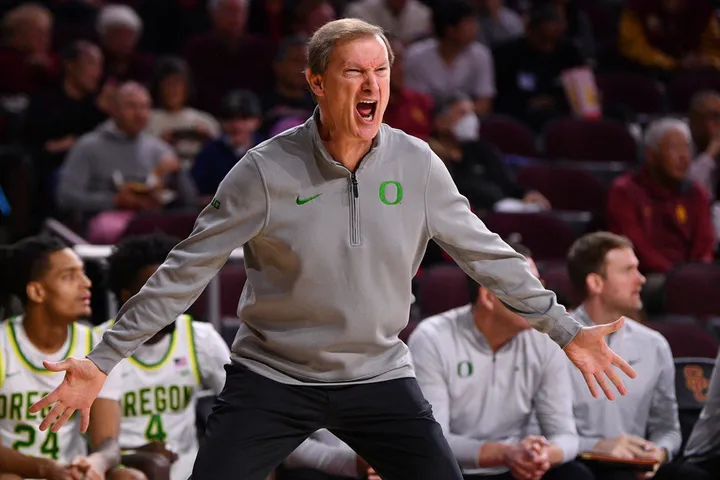
The college basketball season hasn’t even begun yet, and already, the coaching carousel appears to be in motion. Longtime Oregon basketball coach Dana Altman announced his retirement on Oct. 7, less than a month before the start of the season.
It’s the third consecutive year that a longtime coach has left a Power 5 program just before the season. Two years ago, Virginia lost Tony Bennett, replacing him with Ron Sanchez. That didn’t work out, as Virginia finished 15-17, and Ryan Odom came in to replace Sanchez for 2025.
Last year, it was Bruce Pearl stepping away from Auburn. Pearl’s decision seemed more about setting up his son, Steven, with a quality SEC job. The younger Pearl experienced some growing pains but went on to win the NIT in his first year on the Plains.
At 68, Altman’s retirement isn’t quite as stunning as Bennett’s was. And unlike those other programs, Oregon had a former Power 5 head coach waiting in Tony Stubblefield, who previously led DePaul. That leaves the Ducks in a better position than the Cavaliers or Tigers found themselves in.
But Altman’s departure is still a major warning sign for college sports. Here’s why.
When the Love of Coaching Isn’t Enough
You don’t start a season with practice unless you actually want to keep coaching. Altman wanted to complete this season with the Ducks, but his health became a factor. He admitted that he wasn’t sleeping through the night anymore, and his overall health was suffering as a result.
At some point, you reach a point where even things you love feel overwhelming. Altman clearly loves coaching basketball; he’s done it continuously since he was 30. Between Marshall, Kansas State, Creighton, and Oregon, Altman has never been anything but a head coach since 1989. But he had reached the point where he could no longer physically do it because the job was just too much.
All coaches have to sacrifice something in order to succeed. For some, it’s time with loved ones. For others, it’s their health. Over time, those sacrifices take a toll because coaches are human, too. It’s easy to forget that the people we watch on television each night have lives outside of sports. And while the money may make some of their struggles easier, it certainly doesn’t eliminate them.
Altman’s body had reached a point where it simply couldn’t take the demands of coaching anymore. It’s a lesson other coaches have learned as well: they can’t continue pushing their bodies to the limit, especially when their teams depend on them. In 1995, Duke coach Mike Krzyzewski nearly retired because he hadn’t allowed his back to fully heal following surgery. He was spending more time struggling to get out of bed than coaching his team, and the Blue Devils suffered as a result. He eventually prioritized his health during the 1995 season, got the rest he needed, and returned to win three more national titles.
That Duke team finished 13-18. As Krzyzewski understood, when a team needs its coach to lead, that coach has to be close to 100%. Unfortunately, Altman’s physical health appears to have left him much closer to 0%.
The New Reality of College Coaching
Altman, like Tony Bennett, was the kind of coach who enjoyed building relationships with his players and helping them develop over several years. But that’s no longer how college sports operate. These days, conversations often begin with agents and financial arrangements before shifting to basketball itself. And even then, the focus is often limited to the upcoming season. If players aren’t getting the playing time they want, they can simply enter the transfer portal.
Altman really needed a general manager to handle that side of things. He hasn’t made a secret of his dislike for dealing with agents, and it couldn’t have been easy to look at Oregon’s football program and see the support structure Dan Lanning has in place.
Lanning has a general manager in Tyler Dean and, perhaps more importantly, a chief of staff in Marshall Malchow. With that support, Lanning doesn’t have to worry about dealing with agents and can instead focus on coaching and motivating his team. And he’s done a fine job of it, with Oregon reaching the College Football Playoff in each of the past two seasons.
Altman’s Ducks, meanwhile, finished 15th in the Big Ten last year. On the one hand, the situations are different because Altman has far fewer players to manage than Lanning. On the other hand, Altman still isn’t equipped to deal with agents, nor does he want to. It’s a challenge that could have been addressed.
Something Has to Give
There’s no denying it: coaching has become a year-round job. That’s simply not sustainable, and it’s leading more coaches to step aside for their mental health. There was a time when coaches and players alike could enjoy an offseason, but those days seem to be gone.
Players are spending far too much time on the court, while coaches are spending far too much time in the gym. Neither has enough time to step away from the game, recharge, and spend time with the people they care about.
Over time, that takes a toll. And the NCAA needs to address it by closing the transfer portal for months at a time.
With the college calendar divided into semesters, the NCAA could establish a rule preventing players from transferring until the semester ends. For example, the NCAA basketball season concludes in the first week of April. Keeping the portal closed until graduation in mid-May would give coaches roughly six weeks to step away and recharge.
That kind of break could have helped someone like Altman rediscover his passion for coaching and eventually walk away on his own terms. It would also give coaches some much-needed time away from the game rather than forcing them to push through the fatigue of another long season.
College basketball has long been defined by the coaches who build programs, develop players, and leave lasting legacies. But the modern game is asking more of those coaches than ever before, often at the expense of the very things that drew them to coaching in the first place.
Dana Altman's retirement should be more than another headline in the coaching carousel. It should be a warning. Because when the game becomes too demanding for the people who love it most, college basketball has a much bigger problem than finding their replacements.

