Early-season college football rankings have a way of rewarding wins and punishing losses, sometimes without enough consideration for who those wins and losses actually came against. Not all records are created equal, especially when the best teams in the country are willing to play each other.
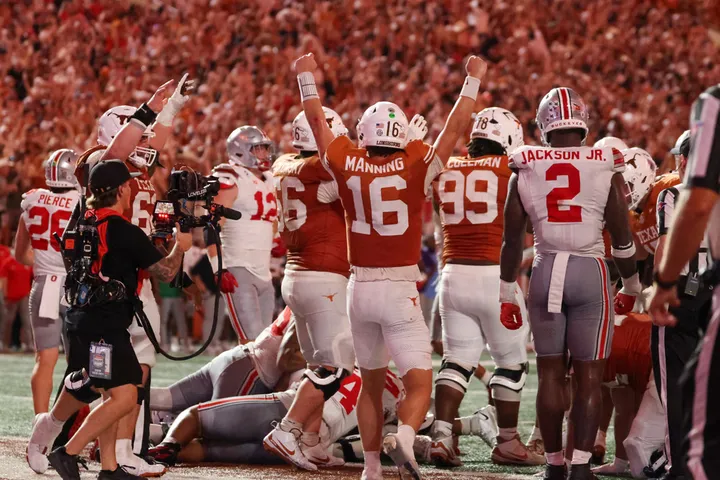
Texas earned the No. 1 ranking after beating Ohio State, a victory that stands as one of the most impressive wins of the college football season.
But while the Longhorns were rewarded for that performance, Ohio State dropped to No. 6. And that seems like an overly harsh outcome given the quality of the Buckeyes’ only loss.
Ohio State is the only team in the AP top 20 that isn’t undefeated, so the Buckeyes aren’t exactly being disrespected at No. 6. But that kind of drop still sends the wrong message. Realistically, Ohio State should sit no lower than fourth in the nation, and a case could be made for putting the Buckeyes second. Here’s why.
Reward Teams Who Schedule Tough
Texas coach Steve Sarkisian raised the issue after the game: if teams are consistently punished for losing matchups like Ohio State-Texas, they’re going to have less incentive to schedule them. At some schools, that approach may already be taking hold.
Indiana coach Curt Cignetti hasn’t shown much interest in loading up the nonconference schedule. Indiana canceled a series with Notre Dame, and the Hoosiers currently have no games scheduled against Power 4 opponents outside the Big Ten for the rest of the decade. While Ohio State was going toe-to-toe with Texas, Indiana was cruising past Howard.
Ohio State has taken the opposite approach. The Buckeyes played a home-and-home with Texas over the past two seasons. Next year, they’ll welcome Alabama to the Horseshoe before traveling to Tuscaloosa in 2028. After a year off, they’ll begin a home-and-home with Georgia in 2030.
That kind of scheduling should be rewarded, or at the very least, it shouldn’t be punished. A one-point road loss to one of the best teams in the country can tell us more about a team than a comfortable win over an overmatched opponent.
That’s the larger issue with dropping Ohio State behind teams that haven’t faced the same level of competition. It creates an incentive for coaches to protect their records rather than test their teams. If college football wants more marquee nonconference games, teams need a tangible reason to keep scheduling them.
The Outcome Shouldn’t Be All That Matters
The way a team performs often tells more about it than the final score. For three quarters, Ohio State looked like the best team in college football. The Buckeyes tested themselves against another elite program and proved they could match them, and even exceed them when at their best.
It fell apart over the final 15 minutes, and that’s something Day needs to fix. But it’s far better for his team to learn those lessons in September rather than January. Last year, Ohio State didn’t get tested after Texas until it faced Indiana in Indianapolis. The Buckeyes couldn’t handle the adversity, fell to Miami and saw a brilliant season end in ashes.
Day learned from that and wants to maximize learning opportunities for his program. But properly evaluating those games requires voters to look beyond wins and losses and consider what actually happened on the field.
That has long been a flaw with the polls. With games stretching from noon until well after midnight on Saturdays and ballots due before the new rankings are released Sunday, it’s impossible for voters to thoroughly watch every relevant team each week. Inevitably, records, final scores and box scores become a major part of the evaluation.
But that can obscure what the games themselves tell us. Ohio State lost to Texas, but the performance showed that the Buckeyes belong among the best teams in the country. A one-point loss on the road against an elite opponent shouldn’t erase that.
Not All Results Are Created Equal
This goes hand in hand with rewarding teams that schedule tough opponents, but it points to another flaw in the polls: teams are often punished simply for losing, even when the result is exactly what the rankings suggest should happen.
Home-field advantage matters. Ohio State was a 1.5-point underdog at Texas, and if the Longhorns were truly one of the best teams in the country, they should have been expected to win on their home field against almost anyone. They did, and deserved credit for it.
But Ohio State shouldn’t automatically be punished simply because it lost. This fallacy shows up often in the polls, usually in much more extreme cases. You’ll see the No. 15 team in the country go to the No. 4 team, lose by a field goal and drop to No. 21 the next week. But the No. 15 team in the country should lose a close game on the road to the No. 4 team. Doing what was expected shouldn’t automatically result in a drop.
Very rarely will voters buck the trend and resist the urge to punish a team that lost. It does happen, such as in 1997 with Missouri and Nebraska. The Tigers came into that game unranked and 29-point underdogs to the Cornhuskers. Missouri instead nearly beat Nebraska, but came up a play short on the famed “Flea Kicker” play that forced overtime. The voters noticed and moved the Tigers to No. 23 for taking Nebraska to the brink.
That’s the kind of mindset pollsters should bring to evaluating teams. The question shouldn’t simply be whether a team won or lost, but what its performance says about how good that team actually is. Ohio State went on the road against an elite opponent and outplayed Texas for much of the night. The Buckeyes lost the game, but that performance still provided plenty of evidence that they belong among the best teams in the country.

