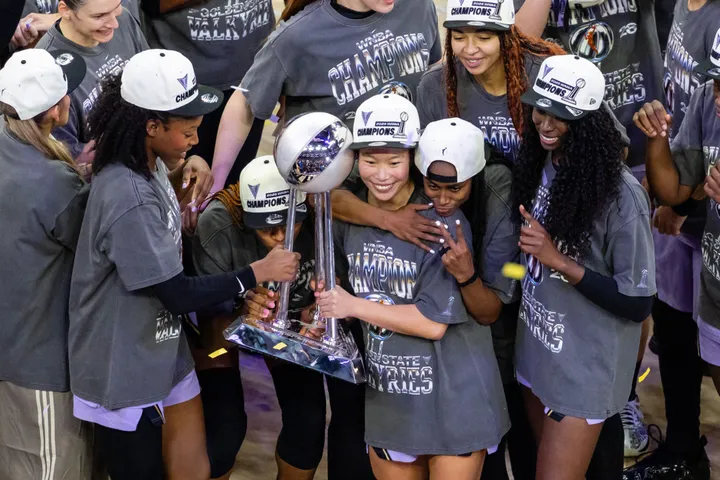
When she was given the final word after the Golden State Valkyries’ WNBA championship victory, Tiffany Hayes didn’t hesitate.
“This is just what happens when you invest in women's sports," Hayes said. "We're here. We ain't going nowhere. Invest in women's sports, baby. Let's go!"
She’s absolutely right, and the Valkyries’ seven-game championship victory over the Atlanta Dream proved her point. All seven games were sold out, despite the scheduling issues with State Farm Arena for the Dream’s home games. Atlanta fans had to show up at 12:30 p.m. on a weekday to accommodate a scheduled Hawks game, and they still sold out the building in minutes.
That’s huge. And it’s far from the only sign of the growing momentum behind women’s sports.
The PWHL continues to break attendance records, and it’s adding four new markets this season. Women’s professional baseball had a strong first season and appears primed to build in year two. There are multiple pro volleyball leagues that attract loyal crowds. The NWSL offers some of the world’s best soccer, and the Women’s World Cup takes place next summer.
You get the idea. There’s a lot of action in women’s sports right now. And now is a great time to invest in them, for multiple reasons. Here’s why.
A New Generation of Fans Is Building Its Own Loyalties
Women’s sports represent a different market than men’s sports for a couple of important reasons. First, their fan bases aren't nearly as established. Many men’s professional sports teams have been around for more than a century, allowing loyalties to develop and pass from one generation to the next.
There are exceptions, but for the most part, fans of men’s sports often inherit their allegiances. If your grandparents and parents supported a particular MLB or NFL team, chances are you grew up rooting for that same team, especially if attending one of its games was among your earliest sports memories.
Women’s sports don't have that same generational history, as most professional women’s teams have only existed for the past 30 years. Many fans discover these teams as adults, when they're forming their own preferences rather than inheriting them. As a result, they may be more deliberate in choosing teams that reflect their personal values.
That leads to the second major difference: Women’s sports fans tend to place a greater emphasis on inclusivity. One reason the Valkyries have developed such a loyal following is their commitment to making inclusion a central part of their identity. Recognizing that many women and LGBTQ+ fans haven't always felt welcome in men’s sports, the organization has worked to create an environment where everyone feels they belong. And the response has been overwhelming. Golden State fans have embraced “Ballhalla,” taking pride not just in the team itself, but in the community it has created.
When fans feel that a team is genuinely invested in them, they're more likely to return that support. And right now, women’s sports are providing some of the strongest examples of what can happen when organizations understand their audiences and make them feel valued.
An Inclusive Fan Experience Drives Engagement
For decades, there’s been a stereotype that women aren’t interested in sports. That couldn't be further from the truth, and men’s sports offer plenty of evidence. According to recent NFL surveys, 47% of NFL fans are women. The issue isn't that women dislike sports. It's that they haven't always felt welcomed or respected as fans.
One reason women may be less vocal about their fandom is that they’re often expected to prove their knowledge and credibility in ways men aren't. Many women know and understand sports just as well as, if not better than, their male counterparts, yet they don't always receive the same respect. Look at the comments under a social media post from almost any woman working in sports, and you're likely to find criticism that her male counterparts rarely face.
Women’s sports leagues offer a different environment. As long as someone comes to women’s sports in good faith, most fans don't care whether they've been following the WNBA since 1997 or are still learning the shot clock rule. That welcoming atmosphere encourages fans to engage with one another, attend games, purchase merchandise, and share their experiences with friends.
Women who love sports have long represented an underserved audience with tremendous potential. And as women’s sports continue to grow, the teams, organizations, and businesses that recognize and invest in that audience today could be among those that benefit most in the years ahead.
The Product Keeps Getting Better
If you haven’t taken the time to watch women’s sports, you’ve really missed out. The competition keeps getting better every year, and the reason is simple: the talent pool continues to expand.
As opportunities for women in sports grow around the world, young girls with athletic ambitions can now see more paths toward making their dreams a reality. And as more athletes pursue those opportunities, the level of competition rises, bringing even greater talent to the professional ranks.
Women’s soccer is a great example. From 1991 through 2007, six countries largely dominated the sport: the United States, Germany, Norway, Sweden, Brazil and China. Those nations had a massive advantage because they invested early in their women’s teams. With the exception of Canada’s fourth-place finish in 2003, those six countries claimed every top-four finish in the first five Women’s World Cups.
That began to change in 2011 as more countries invested in their programs. Japan won its first title that year, and France reached the semifinals. By 2023, Sweden was the only one of the original Big Six to even reach the quarterfinals. And the competition should only become more intense next year.
The same trend is taking shape in domestic women’s sports. With more opportunities to play professionally in the United States, young athletes have greater incentive to pursue their ambitions. That means a deeper talent pool, stronger competition and an even better product for fans, creating more opportunities for the next generation.
There’s every reason to believe the WNBA’s showcase series was only the beginning. Between passionate and growing fan bases, a more welcoming environment and an expanding pool of talented athletes, women’s sports have all the ingredients for continued success.
And as more leagues, teams and businesses recognize that potential, the opportunities will only grow. Women's sports have already demonstrated what can happen when they're given the resources and attention they deserve. The question now isn't whether they're worth investing in, but how much bigger they can become.

